Green case study #4: whats in it for me?

July 27, 2008 – 7:59 pm

Its the business owner’s bottom line, after any pitch or presentation about anything, especially for a relatively unproven niche market like “green” building or design: how does this product/service/alternative help me and my business make money?

If you own or manage a business and read any of these articles about “green” MDF, you’re probably asking this same question from a slightly different angle: sounds good, especially the health stuff, but how much extra is it going to cost?

While susceptible to the second approach, I prefer the first because it opens up a whole new perspective on the everyday issues facing business owners, managers and entrepreneurs that have become increasingly grim over the last couple of years: the radical decline in value of real estate, stock and other investments, the credit squeeze on business brought on by the credit “max out” of the general consumer, the rise of gas prices and fall of foot traffic, the ridiculous cost of healthcare, unfavorable price competition from China and other emerging global economies, degradation of our own water, air, climate and health as a result of business activity, etc.

After visiting the Hospitality Design Expo in May, I saw one of the ways in which the solutions necessary for positive change on the environmental front can cause positive developments in other areas of concern to business owners, including financial concerns.

In other words, to echo Bill Clinton, Al Gore, and several other forward-looking leaders in our society, there is economic opportunity in the growth of green for business owners, because there is authentic demand for what “green” design can deliver to practitioners, consumers and local economies alike.

So how does it work? And what does any of this have to do with picture framing?

It will take a few more posts to sort through all this even as just an overview, so I will start by concluding this post with what I think is an important piece of context for discussing green design.

A good chunk of small business/entrepreneurial growth in the US over the last ten years has been in businesses that have leveraged cheap labor abroad and cheap energy to ship overseas goods cheaply into our country. At the same time, many business have learned to leverage the internet in order to reach new customers at great distances and leveraged other services like Federal Express and UPS to fulfill those far away sales, opening up new markets and accelerating the spread of information and market presence well beyond traditional regional and word-of-mouth boundaries.

Unfortunately, the particulars of the unprecedented global economic growth characterizing the beginning of the 21st century include some nasty side effects, including counterfeiting, trademark and copyright infringement;  severe environmental pollution, widespread health problems;  small business failure and greater unemployment due to overseas competition and “outsourcing”; and occasions of dangerous “goods” being marketed here at home.

These negatives, coupled with the radical rise in energy and transportation costs, create the opening for  green design and green products to flourish in economic terms.

For instance, we are currently seeing a surge in gas prices that is crimping many segments of the US economy and directly impacting thousands and thousands of our fellow citizens who have built their homes, families and businesses around a driving lifestyle.

The car makers ahead of the curve on smaller high mileage vehicles are the new #1 and #2 selling carmakers in the United States for the first time in history and employ more workers and have made more investment in local communities through expansion and growth over the last ten years than their newly deposed American counterparts.

In theory, greater demand for these “green” vehicles should spur growth and investment, so that ultimately, through innovation and foresight, higher gas prices=more new jobs and opportunities— rather than less.

In our business at The Frame Maker, freight and handling charges on some of our most unique frames made custom outside of San Diego county have grown so high that we are now building a network of artisans here in San Diego in order to keep these one of a kind custom frame designs both affordable to our clients and profitable for us. So, high energy costs=more work opportunities for local artisans.

Similarly, many people have suffered through health problems (or their loved ones have) brought on by exposure to toxic substances. As people become more aware of what chemicals are actually used in their mattresses, carpets, and furniture, and the fact that those chemicals continually leech out into their surrounding environment,  so the demand grows for alternative products that reduce or eliminate the use of these substances. Sierra Pine’s “Formaldehyde free adhesive system” for making MDF is a great example of green design turning a health and environmental negative into an economic positive.

So while recycling is great (and we’ll talk about that soon in relation to the picture framing industry), its the spirit of innovation in green design that interests and excites us here at The Frame Maker– more in the next post.

Green case study part 3: clean, green MDF

June 29, 2008 – 4:58 pm

There are solutions for some of the “green” issues I’ve discussed about MDF- what’s it made from, what its made with, and so on– and I mean real solutions in the form of product available in the marketplace today.

Check out Sierra Pine an established wood-composite manufacturing company that supplies a number of products to the design/build industries, including MDF sheet goods, particle board and mouldings made from MDF as well.

Their sustainable product line features water resistant MDF for wet areas, fire-retardant MDF for modern building code requirements, mouldings, basic building sheets ALL from a sustainable source and process:

“SierraPine’s structure is centered on the use of 100% recycled or recovered fiber, and through strategic investment, is a major consumer of post-consumer recycled wood waste that is diverted from the waste stream. In addition to the use of post-consumer recycled fiber, one of SierraPine’s core values is that all fiber we use originates from sustainably managed forests and agricultural operations.

SierraPine has been an industry leader for two decades in the production of composite panel products that utilize formaldehyde-free adhesives. Our commitment to furthering the development of this and other ultra low emitting resin technologies in all our operations has been demonstrated by the new products we continue to introduce into the marketplace that have been engineered for specific applications.” (from sierrapine.com “Environmental Policy Statement”)


They take their statement a step further by addressing some of my points about energy usage and the mechanics of the manufacturing process:


“SierraPine is also committed to ensure environmental compliance in the communities in which we operate. This includes constant investment in equipment and process control that reduces energy and water usage. We achieve this commitment by setting high expectations for environmental performance, training employees on regulatory and operating permit requirements, ensuring regular inspection of manufacturing facilities and holding all employees accountable for their actions and safe work practices. We will continually integrate environmental stewardship into our daily work activities.”


Sierra Pine’s presentation of their sustainable materials includes one final component that makes them an excellent example of and introduction to the world of green building materials, and I will talk about that in detail in the next post here.

Green case study part 2: MDF

June 24, 2008 – 6:48 am

In the last post I talked about how, even if the materials are recycled, the product is not necessarily “green” if, for instance, it sucks down an immense amount of energy from conventional oil/coal/other environmentally disastrous energy technology. Utilizing alternative energy sources like solar, wind or geothermal power to process the materials and manufacture product would help maintain a robust “green” label for a product.

Another factor in deciding what’s actually “green” is what I’ve come to think of as the “secret ingredient” or “magic wand” that transforms recycled waste into new useful product.

As I mentioned before, MDF is a marvelous building material for certain applications because of its stability, strength and the ease with which it can be machined.

So what do they add to shredded, pulped wood fiber to make it into an ultra durable building material? What’s the binder? What makes it work?

The dirty secret of MDF production has been the use of urea and formaldehyde as binders. Both are carcinogenic, and each have additional nasty health side effects.

When MDF is cut, shaped or sanded, the resulting dust is extremely fine and easily absorbed/inhaled deeply. If the dust is saturated with toxins, imagine how much more of a hazard working with MDF poses. I know from years of furniture making that MDF dust is light, fluffy and easy to snort up your nose even when wearing masks or respirators because it hangs around your hair, clothes, etc.

At any rate, you see my point about researching the technologies behind new wonder products for the green design market, because there might be some scary toxin(s) hidden in the manufacturing process.

And if you think it doesn’t matter if you don’t work with it, think again. The engineered wood industry (and a lot of other people) are all coming to grips with the notion of interior air quality and “emissions” from chemicals (used in the manufacturing process) into the air (as materials break down) over time.

This means chemicals, some of them known (at least in California) to cause cancer, regularly release into the air you breathe inside your home, hotel room or favorite restaurant from your chair, cabinet or crown moulding–

rembering that the ability to cheaply machine MDF into massive decorative architectural shapes, mouldings, baseboards, raised panel doors, wall panels, and anything else that designers can think of means that MDF is everywhere around us, especially in the hospitality industry.

A real “green” building solution to this dilemma would be to make MDF without the cancerous agents as binders and I am pleased to report that the US has (at least) two companies providing real solutions in this niche– I will write about them in the next design post, along with another engineered wood company who is on to the same thing.

Because the urea/formaldehyde issue affects more than just MDF, but also the plywood, oriented strand board, particle board (hello Ikea) and engineered wood flooring (Pergo, Tundra and the like) areas of the market and ultimately the entire spectrum of home/hospitality design & furnishings based businesses.

I believe there are similar issues with uphosltery fabrics and fillers, but its beyond my scope here, which begins and ends as a picture frame maker. Why do we care about all this MDF/emmissions/formaldehyde talk?

There’s not much wood in a picture frame anyway.

There are two reasons why we at The Frame Maker care about the “green” issues being discussed here.

1. We care about our own health and yours.

2. If the “wood” in your frame is slowly polluting the atmosphere outside the frame, what do you think is happening inside the frame?

Framers have been sealing regular wood frames for decades to prevent the migration of acids/tannins from the wood of the frame into the art package, now we have to consider that the use of composite materials for picture frames may expose the art to harmful substances as well as art handlers.

Green case study part 1: MDF

May 30, 2008 – 7:23 am

To try and get a handle on all the facets of being green when it comes to interior design, building materials, and the like, I decided to explore a material widely used in interior finishing work, furniture manufacture and more recently in custom framing as well: medium density fiber board, known mainly as MDF.

At the HD Expo, I stopped to speak with one contract framer who had a US Green Building Council  Certificate up on their booth and some other “green” group signage– I don’t remember what exactly, because of their response to my question: “So what green products do you offer for our (art & framing) industry?”.

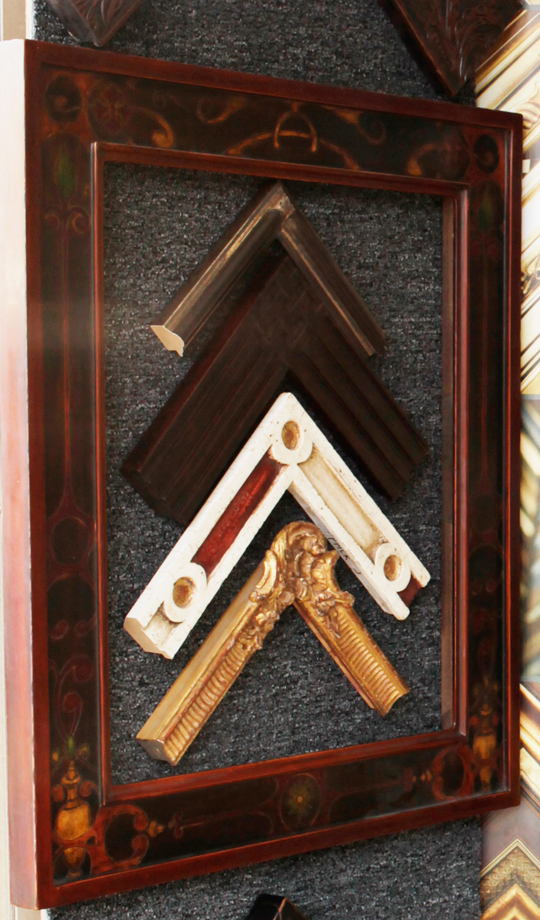
The salesman held up a frame corner sample made of MDF with a silver foil finish, claiming it was a green product. When I asked what else made them a “green company”, he had nothing else to say.

When I pressed, his claim for MDF being green rested mainly on the idea that MDF is a “recycled” product, utilizing either post-consumer waste or wood industry by-products in its manufacture. Further, he couldn’t tell me where the MDF came from (company or country) or how it was actually made or how much of it actually came from recycled raw materials. (Most people are probably familiar with the phrase “Contains 30% recycled content”, or 40% or more, when discussing paper products like coffe cups or newsprint).

Now, even if the “recycled content” claim were true, there are several other factors to consider when determining if a building product is green. I will look into these considerations over the next couple of posts; for now lets discuss MDF and how green it may be in terms of its origins and manufacture.

A little research shows that the preferred  raw material for MDF is wood fiber, properly prepared from virgin trees. Most commonly used are fast growing softwoods like the radiata pine used in Australian and New Zealand manufacture of MDF. These trees are raised on plantations like Christmas trees, harvested and replanted in rotation to ensure a steady supply of ready-to-use logs.

Well managed forests and plantations are definitely the foundation of a sustainable wood product industry, its important to distinguish between the use of virgin materials and recycled materials in the discussion of what’s green.

One reason for this is that there is a considerable amount of waste in the wood industry and it makes sense to put this waste to work in engineered wood products like plywood, particle board, oriented strand board and MDF. If these products are not being made from waste, where does the waste go?

A second reason is the amount of energy consumed in the manufacture of these products. For instance, if we follow a fresh log on its path to becoming MDF, there is a considerable amount of energy consumed by:

1. The “debarking” process, where a machine peels away the bark from the log.
2. The chipper that grinds our log up into small pieces.
3. The “plugging and heating” of the chips that prepares them for the next stage,
4. Where the wood fibers are actually stripped apart by a “defibrator”.
5. Next the fibers are injected with resin and wax in a “blowline”, which processes the fibers with more heat at high velocity so that they will
6. Bond together consistently in an oscillating “pendistor”.
7. The homogenized mass leaves the pendistor to be pressed flat into sheets under high pressure.
8. The pressed sheets are then trimmed and sanded for final delivery.

Imagine the amount of electricity or other fuels required for this manufacturing process– only a small amount can be supplied by waste products from the process (for example, the bark can be burned to heat the fibers) and so must come from other fuels.

Why go through all this?

As a builder and furniture maker as well as picture framer, I know that MDF has wonderful capabilities unavailable in other products: large sheets that are perfectly true, stable, won’t warp, takes paint and laminates with ease, and are consistent from batch to batch.

To produce modern furniture and case work, especially in the volume demanded by hospitality and contract work, MDF is a godsend and its many uses certainly (from the furniture maker’s point of view) ought to justify the energy expended in its manufacture.

As a picture framer I have my doubts, since picture frame moulding is generally speaking long thin strips (similar to the natural shape of trees), what could there to be gained from going through all of this effort to produce big perfect sheets of MDF just to turn around and cut them into the little pieces required for framing?

Maybe if the sheets were 100% recycled and most of the electricty/heat required for processing was generated from wind and solar power, I could get excited about MDF as a “green” product.

So what is green, actually?

May 23, 2008 – 7:51 am

Green is certainly a complicated issue when it comes to the necessities of serving lots of people at once.Acres of carpet, hundreds of chairs and bedframes, thousands of linens, window coverings and picture frames are just a small part of the resources consumed in creating a successful hospitality project. Hospitality design almost seems wasteful by definition.

But these projects are happening regardless, so the answer to “green” must be somewhere in reuse and recycle. Designers and architects in hospitality who are leading the way on green issues make great “adaptive” reuse of existing structures and building components and spec recycled materials. 

This solution is hedged on certain sides with specific challenges; maybe the existing building shell configuration is very inefficient in terms of energy usage, utilization of daylight and insulation. Or maybe the amount of energy it takes to recycle one thing into another is far greater than just “getting a new one”. 

Is solar, wind or energy from other self renewing source immediately available and accesible to a specific building? Or do I have to invest $50,000 plus to get green energy in my building and use up a bunch of resources in the process? 

These kinds of considerations keep conscious business owners awake at night, and don’t even take into account a whole other side of the “green” discussion, which is how these design decisions affect the end users, client, customer, guest whatever you want to call him or her. (We’ll use “client”).  

What about that moldy HVAC system pumping chilled air through your room in Vegas which should otherwise be *baking* 14 stories up under the desert sun? What about the deterioration and emision of certain chemicals used in the manufacture of hospitality products, (carpets for example, or drapes) and its impact on the interior air quality of your room? 

The health considerations of green thinking are enormous when you consider the sheer number of people clustered in hotels, restaurants, malls, casinos and other operating hospitality businesses, using those facilities to “live” (that is eat, sleep, eliminate and otherwise enjoy themselves) day after day after day.  

In the next post I’ll do an example, a consideration of a product used throughout the building, construction and hospitality related industries, picture framing included.

Green hospitality design?

May 16, 2008 – 4:12 pm

(Disclaimer: you’re not allowed to take pictures at this show unless you are “official” press, which I am clearly not, so there won’t be any pictures in these posts.)

If I could have take pictures inside the hall at the HD Expo this weekend, I could show you several very cool products developed to meet the needs of hotel, restaurant, casino and resort designers and developers.

There are so many products claiming the “green design” tag that it seems to demonstrate that the demand has grown huge for green products, no matter what the cost premiums associated with “going green”.

After all, hospitality design is all about multiples, huge multiples, and when you think about the natural resources that could be consumed simply in creating chairs, linens, carpets, mirrors and art for the estimated 6 million new hotel rooms (and the buildings to house them) estimated to be built just in the United States by 2030, it would seem a logical place for an environmental conservation mindset to take root.

But, as we as contract framers well know, large multiples means large dollar amounts and therefore a heavy emphasis on conserving the cost per unit and the costs of delivery when it comes to hundreds or thousands of chairs, linens bedframes or picture frames, and the overwhelming consensus of design professional I’ve spoken to agree that much of the time, cost has been the over riding factor in hospitality industry design decisions.

As someone who has always attempted to walk the walk when it comes to energy conservation and material recycling simply as a matter of personal responsibility, but who has worked in notoriously NOT green industries like entertainment construction, picture framing and custom painting, I find it very encouraging that the need for green design has finally seeped down into the design industry decision making consciousness.

Because the people at this how wouldn’t be supplying it if there wasn’t significant demand.

And one of the most powerful aspects of the hospitality industry is that it creates significant demand by virtue of its very size.

In the next post I’ll start talking about more specifics of what I learned here at the HD Expo about how green design can work itself out in the hospitality design industry, what it could mean specifically to the art and framing business, and to The Frame Maker in particular.

This hopeful thought hovers around the edge of the conversation: perhaps the good “green” example set by destinations like hotels, restaurants and resorts could help spread a greener consciousness as guests return home not just with entertaining experiences and fond memries, but also a practical demonstration of green living, or green design in action.

@ Hospitality Design Expo

May 15, 2008 – 1:37 am

In attending the Hospitality Design Expo this weekend on behalf of The Frame Maker, we as a shop are trying to get a clearer picture of where the hospitality industry is headed, not just as it relates to our own contract framing services, but what’s happening for our professional client base, including many members of the San Diego chapter of the American Society of Interior Designers, who have a booth in the show tomorrow through Saturday in the Sands Expo center behind the Venetian.

Today I attended a few components of HD Expo’s “Green Day” event, which focussed on many specific developments in environmentally friendly practices & products for the hospitality industry. I was struck by several points today, and I’m going to start with the last one and probably most significant one, emphasized repeatedly by keynote speaker Danny Seo, is that so-called “green design” is not just another trend.

Rather, the realities of the global economy and our growing awareness of the impact of our activities on the environment, and what that means for our own heath and well-being (as well as that of future generations), are creating demand in the marketplace for green design and green products.

A lot of numbers got thrown around today, but a more significant and fundamental idea is that the consumer audience that cares about green issues is generally willing to pay more for an organic or green product. As this demographic grows and their demand grows, higher prices for ecologically sound practices and products should be met by increased supply as the more entrepreneurial of our citizens see economic and business opportunity in providing green services and products.

Of course, many of these new products aimed for the hospitality industry are featured at the Expo, so I will continue on this subject tomorrow.

Preservation Tips from the Library of Congress

May 8, 2008 – 4:22 am

The Frame Maker just came across this excellent article on preservation of art and other irreplaceable items on paper in terms of matting and framing, published by the Library of Congress.

In addition to some great specifics for framing your art that we have always recommended (like becoming an educated consumer before you go into the frame shop), this article also gives a solid overview of framing materials and this spiffy exploded diagram of a complete archival framing package that is very useful for anyone who’s never considered what goes on inside a frame.

Library of Congress matting and framing diagram
Archival framing diagram courtesy of the Library of Congress

We also appreciate the sound advice about where to hang your completed custom frames (and where not to) in order to ensure the longest life of the valuable items in your collection. Check out this great article on preservation framing here.

Excellent color resource online

April 28, 2008 – 3:24 am

For a vast array of opinions on color, color theories, interesting color palettes and fascinating color patterns, The Frame Maker recommends the online community www.colourlovers.com, which states as its mission:

COLOURlovers™ is a resource that monitors and influences color
trends. COLOURlovers gives the people who use color - whether for
ad campaigns, product design, or in architectural specification -
a place to check out a world of color, compare color palettes, submit
news and comments, and read color related articles and interviews.

Recent examples of palettes featured on their site:

2008 Color Opinions from Crescent

April 25, 2008 – 5:58 am

Another party heard from on color is the venerable Crescent Cardboard Company, maker of many of the matboards we use at The Frame Maker. Crescent makes a vibrant line of rag mats great for designs involving rich color schemes.

For 2008, Leatrice Eiseman, Director of the Pantone Color Institute, (noted as “the source of the world’s most used color specification system”) gives pleasantly concise “overviews” of different color palettes, or groups of colors to work with as a set. For instance, she describes the “High Profile” palette like this:

Inspired by the styles that have managed to survive the fads and foibles of the past, the High Profile palette presents classic shades of Very White, Raven Black, Claret and Neutral Grey. It gets ts glamorous accent with an impact of Cranberry, Majestic Purple, and glimmering Silver-Renaissance….”

Each palette has a second set of “Design Tip” commentary by “Nationally Renowned Interior Designer” Barbara Schmidt, whose syndicated columns appear in over 50 publications. She has this to add about the “High Profile” collection:

These colors are so contrasting that they force the eye to the art. High Profile is perfect when artwork leads the decor. Its silver and gold tones create texture and shine- another trend we’re seeing with the metal, glass and laquered furniture that is so popular today. Vintage posters are great for this palette….”

Check out the rest of their picks for 2008, beautifully illiustrated at http://crescentpro.com/trends.html.